How do you guarantee the quality of lubricants?
The shelf life of lubricants
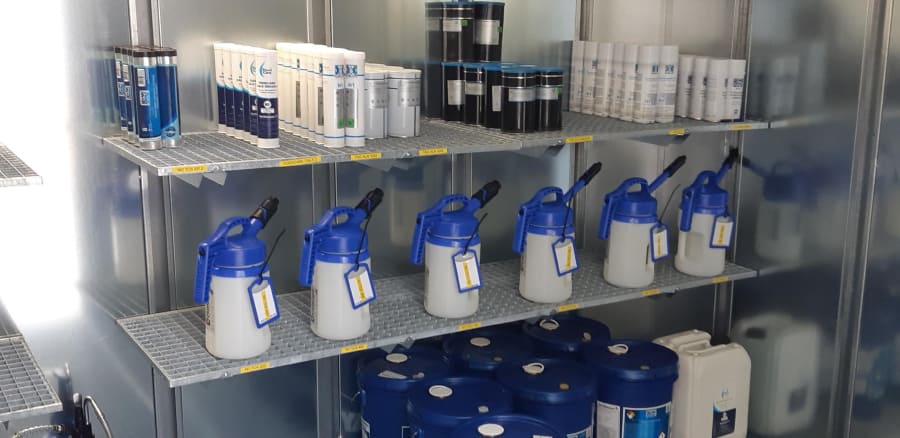
Van Meeuwen supplies high-quality lubricants and maintenance products. To guarantee quality, it is very important that these products are stored under the right conditions.
What are the right conditions?
The correct conditions for storing a lubricant are:
- A constant temperature between 0 and +25 degrees Celsius
- Dry storage
- A sealed package
Opened packaging
If the packaging has been opened, this means that oxygen and possibly moisture or dirt may have come into contact with the lubricant. If this is not the case, the opened packaging can be used up to 2 years after the delivery date. However, if contamination is clearly visible, we recommend not using the product anymore and disposing of it properly.
If the packaging is still closed and sealed, the product will remain usable for up to 3 years after the delivery date.
These shelf-life guidelines only apply to products that are kept in their unopened, original packaging and are stored correctly, protected from direct sunlight, moisture, particulate and atmospheric contamination, and extreme temperature fluctuations.
The storage environment of the products has a significant impact on their integrity. To help our customers assess the long-term integrity of the products, we have established the following guidelines to detect contamination and early signs of degradation.
Storage conditions that affect our products
Temperature
High temperatures and extreme cold can affect the stability of the lubricant. Heat increases the oxidation rate of the oil, which can lead to deposit formation and higher viscosity. Low temperatures may cause wax formation and possible sedimentation. Furthermore, alternating exposure of the product to heat and cold can draw air into the containers, potentially leading to moisture contamination. Ideally, storage temperature should be between 0 °C and +25 °C, unless otherwise specified by the product.
Light
Exposure to light can alter the color and appearance of lubricants. To prevent such changes, lubricants should be stored in their original metal or opaque plastic containers.
Water
Some lubricant additives can react with water, forming insoluble compounds. Water can also promote microbial growth at the oil-water interface. Lubricants should be stored in a dry location, preferably indoors.
Particle contamination
Do not store drums and pails in areas with a high concentration of airborne particles. This is particularly important when storing partially used containers.
Atmospheric contamination
Oxygen and carbon dioxide can react with lubricants, affecting their viscosity and consistency. Keep lubricant containers tightly closed until the product is needed.
Oil separation
Oil naturally separates from most greases. High temperatures or vibration can accelerate this process. When grease is removed from drums or pails, the surface of the remaining grease should be leveled to prevent oil from separating into cavities.
More information?
If you have any doubts about the shelf life of your product or questions about the lubricant, please feel free to contact us.