Van Meeuwen Lubrication
Water in Oil: An Underestimated Risk
Water in Oil: An Underestimated Risk
When we think about lubrication, we often focus on solid particle contamination. That’s understandable, as improving just one ISO cleanliness class can extend the lifespan of sensitive components by 10–30%.
But in many applications, water poses an even greater threat. It doesn’t just damage components—it also affects the oil itself. In this article, you’ll learn how water enters oil, the damage it causes, how to measure it, and what you can do about it.
The Three Phases of Water in Oil
1. Dissolved Water
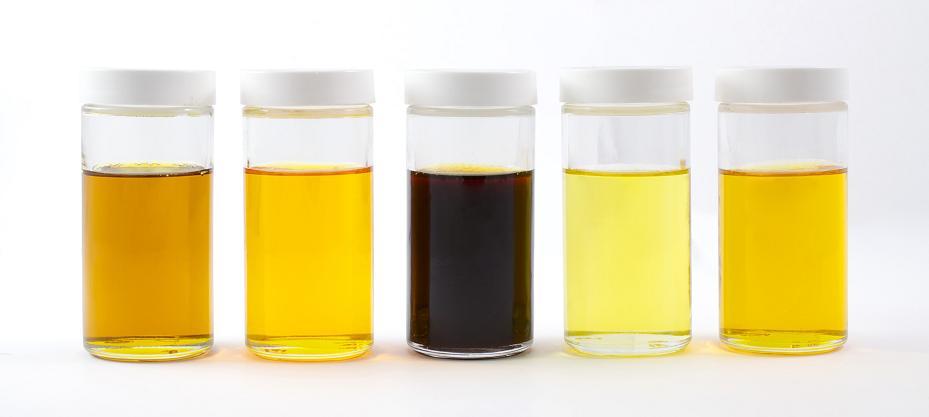
The first condition, known as dissolved water, is characterized by individual water molecules dispersed throughout the oil. Dissolved water in a lubricating oil is comparable to moisture in the air on a humid day: we know the water is present, but because it is distributed molecule by molecule, it is too small to see.
For this reason, an oil can contain a considerable concentration of dissolved water without it being visible. Most industrial oils—such as hydraulic fluids, turbine oils, and others—can hold as much as 200 to 600 ppm of water (0.02 to 0.06 percent) in dissolved form, depending on the temperature and the age of the oil. Older oils can contain three to four times more dissolved water than new oil.
2. Emulsified Water
Once the amount of water exceeds the maximum solubility, the oil becomes saturated. At that point, the water exists in the oil as microscopically small droplets—an emulsion. This is similar to the formation of fog on a cool spring day. In that case, the amount of moisture in the air exceeds the saturation point, resulting in a suspension of tiny droplets of moisture, or fog. In lubricating oil, this “fog” is often referred to as haze, meaning the oil becomes cloudy or hazy.
3. Free water
The addition of more water to an emulsified oil–water mixture leads to a separation of the two phases, creating a layer of free water and free and/or emulsified oil. This is comparable to rain falling when the amount of moisture in the air becomes too high. In mineral oils and PAO synthetic oils with a specific gravity of less than 1.0, this layer of free water settles at the bottom of oil reservoirs.
The Consequences of Water Contamination
In a lubrication system, the two most harmful phases are free and emulsified water. In plain bearings, for example, the incompressibility of water compared to oil can lead to the loss of the hydrodynamic lubricating film, which in turn results in excessive wear. Just one percent water in oil can reduce the service life of a plain bearing by as much as 90 percent.
Emulsified and free water can react with oxygen and cause corrosion (rust) on machine components. Because the effects of free and emulsified water are more damaging than those of dissolved water, a common rule of thumb is to ensure that moisture levels remain well below the saturation point. For most mineral oils, this means 100 to 300 ppm or less, depending on the oil type and temperature.
However, even at these levels, significant damage can still occur. In general, there is no such thing as too little water, and every reasonable effort should be made to keep water contamination as low as possible.
The effects of water on lubricants
Water not only has a direct harmful effect on machine components, but it also plays a key role in the aging of lubricating oils. The presence of water in a lubricant can increase the oxidation rate by a factor of ten, resulting in premature oil degradation, especially in the presence of catalytic metals such as copper, lead, and tin.
In addition, certain types of synthetic oils, such as esters, are known to react with water, leading to the breakdown of the base oil and the formation of acids (hydrolysis).
It is not only the base oil that can be affected by moisture contamination. Certain additives, such as sulfur-containing AW and EP additives and phenolic antioxidants, hydrolyze easily in the presence of water, resulting in both additive depletion and the formation of acidic by-products.
These acidic by-products can then cause corrosive wear, particularly in components containing soft metals, such as Babbitt used in plain bearings and bronze and brass components. Other additives, such as demulsifiers, dispersants, detergents, and rust inhibitors, can be washed out by excessive moisture. This leads to sludge and sediment formation, clogged filters, and poor oil–water demulsification.
Water Measurements
To control moisture levels, we must first be able to detect its presence. Visually, the previously mentioned “haze” or cloudiness of an oil sample can already be an important indication of moisture in the oil.
In this regard, 3-D sight glasses, oil level gauges, or drain bowls on oil reservoirs can serve as valuable inspection tools.
It is also possible to determine the moisture content of a lubricant onsite using a relative humidity sensor. Such a sensor measures relative humidity (%RH).
As mentioned earlier, relative humidity (%RH) indicates whether the oil has reached its saturation point. When the oil is fully saturated, the sensor will display the maximum value of 100%. At that point, it is not clear to what extent an emulsified state or even free water is already present. Although it is mathematically possible to derive a ppm value from the relative humidity (%RH) by comparing it to the oil’s saturation curve at a known temperature, the purpose of this type of sensor is to provide an early, proactive warning of potential problems and to enable screening before sending a sample to a commercial laboratory.
The most accurate method for determining the amount of free, emulsified, and dissolved water in a lubricant is the Karl Fischer titration analysis. When used correctly, the Karl Fischer test can quantify water levels as low as approximately 10 ppm (0.001%) and is the preferred method when precise water concentrations must be known.
Water accelerates lubricant breakdown
Whichever method you use to determine the moisture content in a lubricant, one thing is certain: water is a major cause of lubricant degradation, component failure, and reduced machine reliability.
As with all contaminants, it is important not only to recognize its presence but also to take measures to control or eliminate the source of water ingress.
Where possible, the moisture content in a lubricant should always be kept at least below the saturation limit, and every effort should be made to keep moisture levels as low as possible.
Preventive measures may include the use of hygroscopic breather filters or improving seals. Corrective actions may involve the use of moisture-absorbing filter elements, centrifugal separators, or vacuum dehydrators (vacuum purifiers). Reducing the moisture content in lubricants across all types of equipment can significantly extend both lubricant life and machine service life.
More information?